
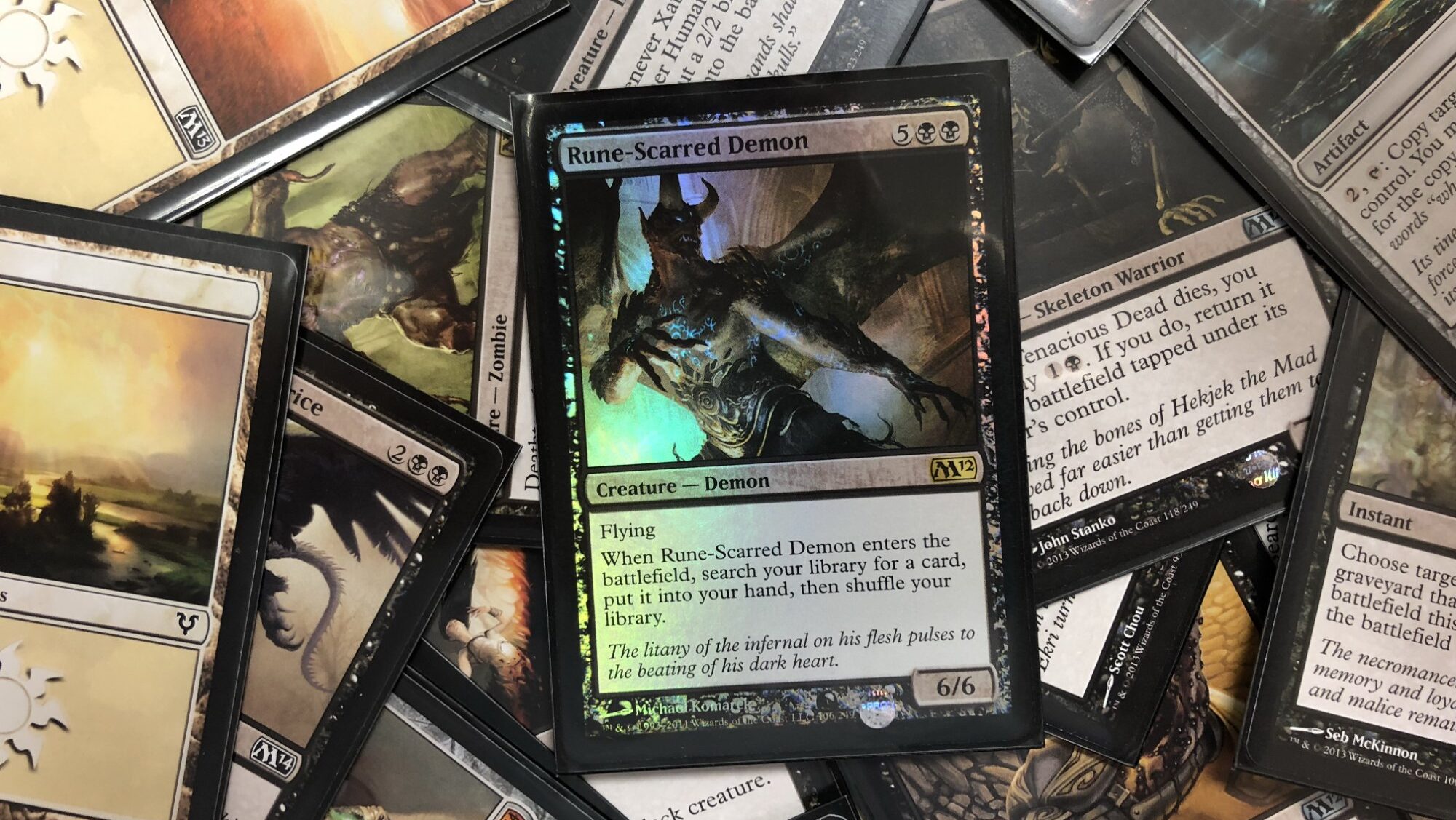
If you’ve ever cracked open one of the MTG precon Commander decks, you already know the appeal: a real, playable 100-card Commander deck in a box, ready for a game night with minimal fuss. No binder diving. No “hang on, i forgot my sleeves.” Just shuffle up, pick your face commander, and you’re in.
But those decks didn’t start as a corporate assembly line. Commander began as a fan-made format (EDH, short for Elder Dragon Highlander), and Wizards didn’t officially step in with dedicated products until 2011. From there, the “precon” idea went from a yearly treat to something that ships alongside major releases, crossovers, and starter products.
Here’s how we got from five wedge decks in 2011 to the modern era where it feels like Commander decks show up… constantly.
What counts as a Commander “precon” anyway?
A Commander precon is a preconstructed deck designed to be played as-is in Commander. Most follow the familiar template:
- 100 cards (including your commander)
- singleton (usually only one copy of any card, basics aside)
- a face commander (the “front of the box” legend)
- a theme you can understand in one sentence (tokens, artifacts, vampires, spellslinger, whatever)
Not every Commander-branded product is a precon deck, though. Some are collections of singles, some are draft-focused sets, and some are “Commander products” that support the format without being a ready-to-play deck. But when people say “precons,” they almost always mean the boxed decks you can play immediately.
Before 2011: EDH grows up in the wild
Commander’s origin story is very “Magic player-coded.” It starts as a casual format built around big legendary creatures, singleton deckbuilding, and multiplayer politics. It spreads because it’s fun, social, and gives your random bulk rares a second life.
In that early era, the “precon” equivalent was basically: “my friend handed me a 100-card pile and promised it worked.” Sometimes it did. Sometimes it was 38 lands and 62 seven-drops. Character building.
The important part is this: Commander was already popular before Wizards printed a single product for it. Wizards eventually recognized there was a huge appetite for a format where the deck is personal, the games are swingy, and the table talk is half the point.
2011: The first MTG precon Commander decks hit shelves
In June 2011, Wizards released the first official Commander product: five preconstructed decks built specifically for the format. This is the moment “Commander precon” becomes a real thing you can buy at a store.
A couple details from that first wave still echo today:
- The decks were three-color “wedge” builds, which mattered because wedge commanders were relatively scarce at the time.
- Each deck was designed with a clear identity and included brand-new cards made for Commander.
- Each deck had an official face commander, plus additional legendary options you could swap in to change the feel without rebuilding the whole deck.
If you’re tracking the history of MTG precon Commander decks, 2011 is the clean starting line. It’s the first time Wizards treated Commander as something worth designing around, not just something players were doing on their own.
2013 to 2019: The yearly Commander releases become “a thing”
After the 2011 debut, Wizards leaned into a more predictable cadence. Starting in 2013, Commander got annual releases with multiple decks each year. And over time, these products developed their own rhythm:
- New legendary creatures that clearly signposted archetypes
- New “Commander-only” designs that didn’t need to worry about Standard
- Reprints aimed at multiplayer staples (plus a bunch of “fine, i guess” filler)
This era is also where the precons start experimenting hard. Some of those experiments became Commander’s best-loved mechanics and deckbuilding templates. Others became cautionary tales you still hear about at game stores like old fishing stories.
Here’s a quick snapshot of the big design beats in those years:
| Year range | What changed | Why it mattered |
|---|---|---|
| 2011 | Official debut, wedge identity | Precons become real products |
| 2013 to 2016 | Annual cycles, bigger design swings | Commander starts getting “made for it” mechanics |
| 2017 to 2019 | Themes get sharper, decks get more focused | Precons become better out of the box |
The “mechanics era”: when precons started shaping Commander gameplay
A huge part of Commander precon history is that the decks didn’t just support the format. They actively changed it.
2014: Planeswalker commanders arrive
Commander 2014 did something that felt borderline illegal at the time: it introduced planeswalkers that could be your commander. That sounds normal now because we’ve had years to adjust, but in 2014 it was a real “wait, what?” moment.
2015: Experience counters show up
Commander 2015 introduced experience counters as a deck-defining theme. The idea was simple: do the thing your commander wants, get experience counters, and scale into bigger payoffs. It’s one of those mechanics that plays cleanly in Commander because the games are long enough for the counter engine to matter.
2016: Partner changes deckbuilding
Commander 2016 introduced Partner, letting you run two commanders if both have Partner. That shifted the whole mental model of commander identity. Suddenly you could mix and match, build four-color piles, and treat the command zone like a toolkit instead of one “main character.”
2017: Tribal focus and Eminence
Commander 2017 was heavily tribal, with each deck built around a creature type theme. It also introduced Eminence on the face commanders, an ability that works from the command zone and the battlefield. Whether you love it or hate it, it’s one of the most important “precon mechanics” ever printed because it showed just how far a Commander-only design could push the rules of normal gameplay.
If you’re trying to understand why modern precons feel more “designed” than older ones, this stretch is why. Wizards learned that Commander players will absolutely build around a mechanic if you give them something that’s clear, thematic, and powerful enough to matter.
2020: Commander decks stop being “once a year”
2020 is the next major turning point in the history. It’s when Commander precons stop being primarily an annual event and start becoming part of regular set releases.
Wizards explicitly talked about bigger Commander plans heading into 2020, and that year delivered:
- Commander decks tied thematically to major releases
- Smaller “on-ramp” Commander decks sold alongside sets (replacing the old “Planeswalker deck” slot)
- Commander decks launching with Commander-focused sets like Commander Legends
Zendikar Rising is a good example of the new philosophy: two Commander decks aimed as entry points, with fewer new cards than the big yearly drops, but still tuned to the set’s themes and sold at a lower price point.
This is where MTG precon Commander decks start to feel less like a yearly celebration and more like a permanent product category. Which is great if you love having options, and… mildly exhausting if you’re the kind of person who tries to “keep up.”
2022 to 2025: Universes Beyond, premium decks, and precons everywhere
Once Commander decks were normalized as part of release cycles, the next wave was obvious: more collaborations, more “big event” decks, and more ways to get someone into Commander quickly.
A few notable milestones:
- Warhammer 40,000 Commander Decks (2022): a major Universes Beyond release built around Commander decks.
- Starter Commander Decks (2022): explicitly positioned as a beginner-friendly entry product with five two-color decks.
- Commander Masters (2023): a premium Commander product that also shipped with preconstructed decks.
- Universes Beyond keeps rolling (2023 to 2025): Doctor Who, The Lord of the Rings: Tales of Middle-earth, Fallout, and Final Fantasy all had Commander decks as part of the product mix.
- 2025 keeps the cadence: major releases like Final Fantasy (June 13, 2025) and Edge of Eternities (August 1, 2025) continued the pattern of Commander deck tie-ins.
By early 2026, third-party trackers put the total number of Commander precons well into the triple digits. At this point, the “history” is also a story about volume: Commander decks went from a few carefully timed releases to a main way Wizards delivers new legends, new mechanics, and reprints.
What changed inside the box over time?
The funny thing is that the shell of a precon hasn’t changed much. It’s still 100 cards with a theme. But the guts have evolved a lot.
Here are the biggest trends you can feel when you play old precons versus newer ones:
The themes got clearer
Early decks sometimes felt like a “Commander sampler platter.” Newer precons are usually more focused. You can tell what you’re supposed to do by turn three.
Staples became expected
Commander precons helped standardize certain cards as format glue. Over time, it became normal for precons to include more universally playable ramp, draw, and fixing because players wanted decks that didn’t stumble out of the gate.
The upgrade path became part of the product
Modern precons are often built with obvious “swap lanes.” There’s a baseline functional deck, and then there are the obvious next 10 cards you’ll upgrade if you like the archetype. That’s not an accident. It’s a design pattern now.
Crossovers changed the audience
Universes Beyond decks pulled in players who maybe weren’t buying Magic sets at all. A Warhammer or Fallout fan can buy one product and get a full Commander experience. That’s a big shift from “you probably already play Magic, here’s a Commander deck.”
Where MTG precon Commander decks are now
So where does that leave us?
Today, Commander precons are one of the main ways Wizards introduces new legendary creatures and new Commander-focused mechanics. They also serve as on-ramps for new players, theme decks for casual pods, and pre-built starting points for people who like to customize.
And if you’re just here for the history lesson: the short version is that Commander decks went from “one bold experiment in 2011” to “a central pillar of Magic product releases.” Whether that’s comforting or slightly chaotic depends on how many unopened precons you have sitting in a closet right now.
Conclusion
The history of Commander precons is basically the story of Commander itself becoming Magic’s main multiplayer engine. It starts with a fan format, gets its first official boxed decks in 2011, finds its identity through yearly releases and wild mechanics experiments, and then explodes in 2020 when Commander decks become part of regular set launches.
If you’re writing about MTG precon Commander decks, the most important thing to capture is that they’re not just beginner products anymore. They’re how Wizards introduces archetypes, tests mechanics, and gets entire new audiences to the table.