
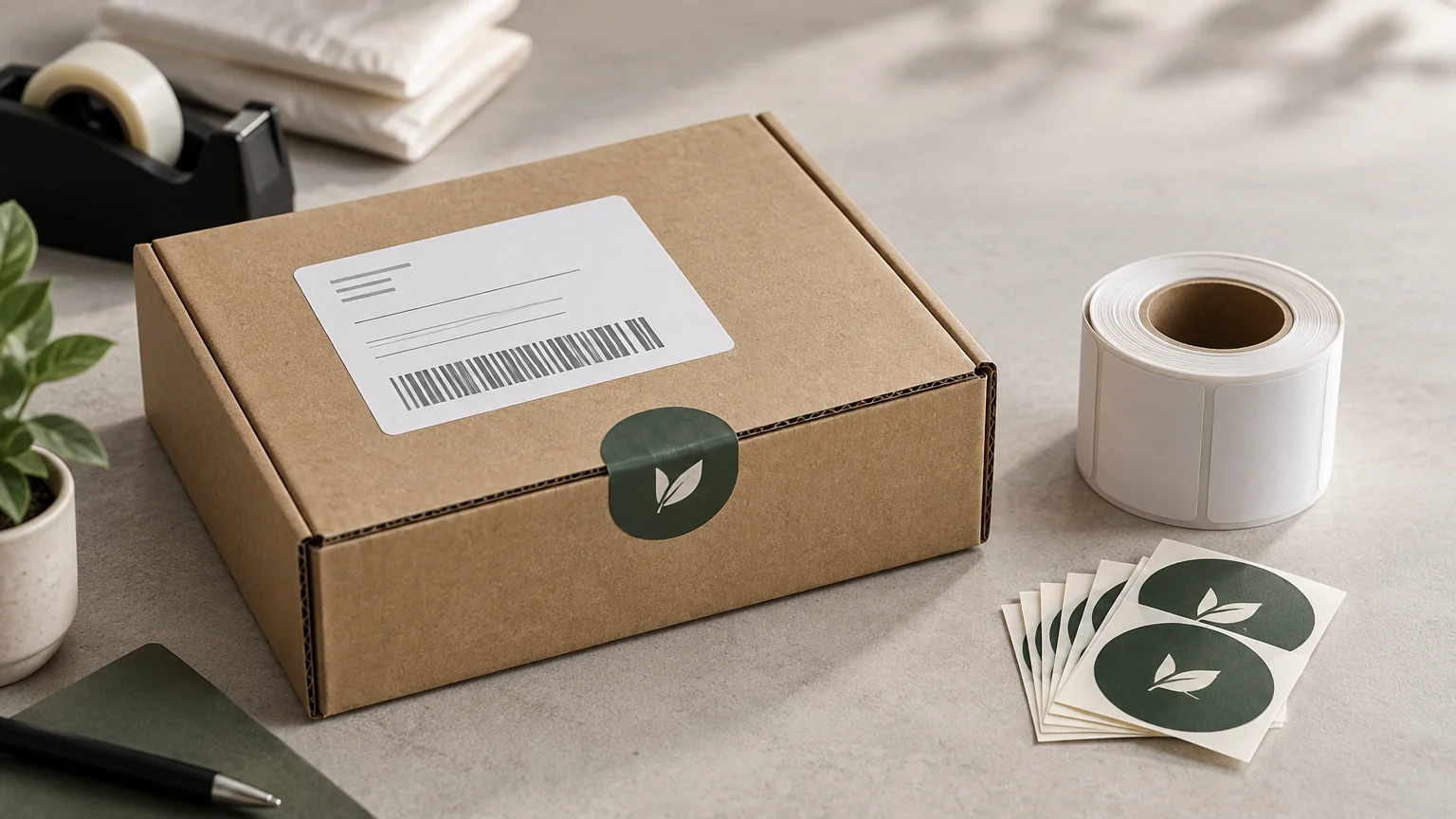
TLDR
In the labels vs stickers ecommerce packaging decision, focus on the job rather than the name. Labels identify, route, track, or communicate information about a product or shipment. Stickers usually add branding, seal tissue, promote a campaign, or become a customer giveaway. One adhesive piece can do both jobs when its information is stable. Keep recipient, carrier, tracking, and other order-specific data in the live fulfillment workflow.
The practical answer is to preprint static information and generate variable information on demand. A logo, product name, SKU, UPC, care instruction, or general QR destination may belong on stocked packaging. A shipping address, tracking barcode, service level, or order-specific instruction usually should not. This distinction makes labels vs stickers ecommerce packaging an inventory and fulfillment question—not merely a printing question.
Labels vs stickers for ecommerce packaging at a glance
| Component | Primary job | Typical data | Production timing | Application point | Common format | Main failure risk |
|---|---|---|---|---|---|---|
| Shipping label | Route and track a shipment | Variable by order and carrier | Generated during fulfillment | Outer shipping container | Printable label stock | Wrong order, poor placement, or unreadable barcode |
| Product label | Identify the product or variant | Usually fixed by SKU; sometimes batch-specific | Preprinted or generated during production | Product, pouch, jar, or retail box | Roll, sheet, or cut label | Incorrect version or unsuitable construction |
| Branded packaging sticker | Brand, seal, decorate, or promote | Usually fixed by campaign or design | Preprinted and stocked | Tissue, mailer, box, insert, or giveaway | Roll, sheet, or individual die-cut piece | Extra packing labor or obsolete campaign inventory |
| Hybrid brand-and-product label | Combine presentation with identification | Stable logo and product information | Preprinted by SKU or variant | Product or primary package | Often a roll or sheet label | Too many label SKUs or crowded information |
The physical products in this table may look similar. The operational differences are data ownership, timing, and application. If a fulfillment system must supply the information after an order arrives, treat the piece as an operational label. If the same artwork can be applied across many orders before the customer is known, it can usually live in preprinted inventory.
Separate the three jobs on the package
Most ecommerce packages carry three information layers. Separating them during planning prevents the brand team, product team, and fulfillment team from competing for the same adhesive component.
- Operational identification and routing: shipping addresses, carrier barcodes, tracking data, warehouse routing marks, and order-specific handling information.
- Product identification and information: product name, variant, SKU, UPC, quantity, use instructions, and other information tied to the item.
- Brand and presentation: logos, campaign messages, decorative seals, social prompts, and stickers intended as extras.
The first layer normally belongs to systems and fulfillment. Shopify, for example, documents shipping-label purchase as part of a broader order-fulfillment process involving fulfillment orders, packages, carrier services, tracking, and printable shipping documents. Operators evaluating an integration should review the platform’s shipping-label workflow documentation rather than treating label printing as an isolated design task.
The other two layers can overlap. A jar label can carry the brand, product name, variant, and UPC. A tissue seal can display a logo while also indicating that a package has been closed. That overlap is useful when it removes a packing step without making inventory harder to control.
Use data volatility as the central decision rule
Ask how often each field changes and what event makes it change. Static fields can be printed in advance. Variable fields should be added as close as practical to the event that creates them.
- Good candidates for preprinting: logos, standard product names, stable SKUs, established UPCs, general instructions, evergreen artwork, and QR codes leading to durable destinations.
- Possible candidates for controlled preprinting: seasonal artwork, short promotions, variant names, and information tied to a production batch. Order conservatively because these components can become obsolete.
- Generate on demand: recipient addresses, tracking numbers, carrier barcodes, selected shipping services, order numbers, gift messages, and other transaction-specific information.
Lot codes, expiration information, serial numbers, and regulated product details need category-specific review. Do not assume they are static merely because they appear on the product package. Their production, traceability, and legal requirements may call for a separate printing process.
A QR code also deserves scrutiny. The printed pattern may be static, but the destination can still change if it uses a managed redirect. Assign ownership for that destination and test it before each production run. Otherwise, a seemingly evergreen label can become a box of unusable inventory.
When one adhesive piece can do both jobs
A hybrid label works best when the product identity and branding change together. Consider a candle company with three scents. Each roll label could include the logo, scent name, SKU, UPC, and standard use information. The picker selects one label by product variant, and the packer does not need to apply a separate logo sticker.
Consolidation is worthwhile when it reduces touches without introducing ambiguity. Before combining components, confirm that the resulting label remains readable, fits the container, uses a construction suited to the package and environment, and can be replenished at a sensible quantity. For a deeper material comparison, see vinyl versus BOPP for stickers and labels.
Do not combine components simply to reduce the number of purchase orders. A universal branded sticker may be easy to stock across the catalog, while product labels remain specific to each SKU. Combining them could turn one shared item and several controlled labels into a larger family of brand-and-product variants. Fewer application steps can still produce more inventory risk.
When the functions should remain separate
Carrier labels are the clearest case for separation. They contain shipment-specific information and must be associated with the correct parcel. Preprinting them with branded packaging inventory would break the connection between the order, selected service, tracking record, and physical package.
Separation is also useful when branding changes more frequently than the product information. A subscription company may rotate tissue seals monthly while leaving its product labels unchanged. Conversely, a company with frequent formula or variant changes may keep an evergreen logo seal while controlling product labels separately.
Keep separate components when they have different owners or application points. Product labels may be applied during manufacturing, branding during kitting, and shipping labels after the packed parcel is weighed. Combining work from different stages can create unnecessary handoffs or require the fulfillment team to maintain information that belongs upstream.
Choose rolls, sheets, or individual stickers around the workflow
Format affects labor as much as appearance. Rolls generally suit repeated application at a dedicated station because labels can be dispensed in sequence. Sheets work for smaller batches, multiple designs, and manual selection. Individually cut stickers make sense for giveaways or situations where the customer receives the sticker rather than the packer applying it.
A supplier offering custom packaging stickers and roll labels can be useful when sourcing static branded components, but the purchase specification should come from the actual workflow. Define the application method, finished size, quantity by design, package surface, expected handling, storage environment, and whether rolls must feed through a dispenser.
CustomStickers describes roll labels as a repeated-labeling and packaging format and lists paper, white and clear permanent BOPP, holographic, matte, and silver BOPP among its options. Those are supplier-specific offerings, not proof that every material fits every package. Confirm the selected construction against the product surface, exposure, and application method.
If the order is a prototype, a short campaign, or a launch with uncertain demand, minimizing obsolete inventory may matter more than achieving the lowest unit cost. For urgent replenishment, distinguish true production speed from shipping speed; our guide to custom next-day labels explains why that difference matters.
Design the package and packing station together
Reserve a clear zone for the shipping label before decorating the outer package. FedEx advises placing a label on the package’s largest flat surface and provides alternate guidance for packages where an edge or seam affects placement. Its shipping-label placement guidance is a useful reference when creating packaging templates.
A branded closure should not force the carrier label over a seam, around a corner, or across another barcode. Likewise, decorative graphics should not resemble routing marks or create confusion near machine-readable information. Test the packed parcel—not only the empty box—because bulging, folds, tape, and closure methods can alter the usable label area.
Packing-station checklist
- Map which component is applied during manufacturing, kitting, packing, and shipment closeout.
- Give every stocked label or sticker a distinct inventory name and storage location.
- Use visual differences where similar product-label variants could be confused.
- Reserve an unobstructed, flat area for the carrier label.
- Keep unrelated barcodes away from the shipping-label zone or cover obsolete transport labels when reusing permitted packaging.
- Confirm that the package surface, temperature, moisture, handling, and storage conditions fit the selected adhesive construction.
- Test scans and placement on a fully packed sample.
- Set reorder points using consumption rate, lead time, minimum order quantity, and expected artwork changes.
- Retire obsolete packaging components promptly so they cannot return to active pick bins.
Worked example: a subscription skincare shipment
Imagine a skincare company shipping three products in a monthly subscription box. The products have stable names and variants, while the tissue-seal artwork changes each quarter. Customer addresses and shipping services change with every order.
The company stocks one product-label roll for each stable SKU. Those labels carry the logo, product identity, SKU, and other approved fixed information. It also stocks a limited quantity of the current tissue seal. The seal is treated as campaign inventory, not as a product identifier.
At the packing station, the picker verifies the products, the packer closes the tissue with the current seal, and the fulfillment workflow generates shipment documents for the completed order. The shipping label is applied last in the reserved exterior zone. This keeps customer and carrier data connected to the transaction while letting the brand update its unboxing presentation without changing every product label.
If the company later adds automation, it can evaluate where print events belong in the order flow. Our overview of automated print fulfillment for Shopify stores provides broader context for routing ecommerce orders into production and fulfillment systems.
The practical recommendation
Default to two systems: static printed inventory for product information and branding, plus on-demand output for transaction-specific fulfillment data. Combine a label and sticker only when the information is stable, the same team applies it at the same stage, and consolidation reduces both labor and inventory complexity.
Start by listing every adhesive component on one current package. Mark each field as static, campaign-based, SKU-specific, batch-specific, or order-specific. Then assign its owner, application point, and replenishment method. That short exercise will usually reveal which pieces belong on a preprinted roll, which can remain decorative stickers, and which must stay inside the live fulfillment workflow.