
TLDR
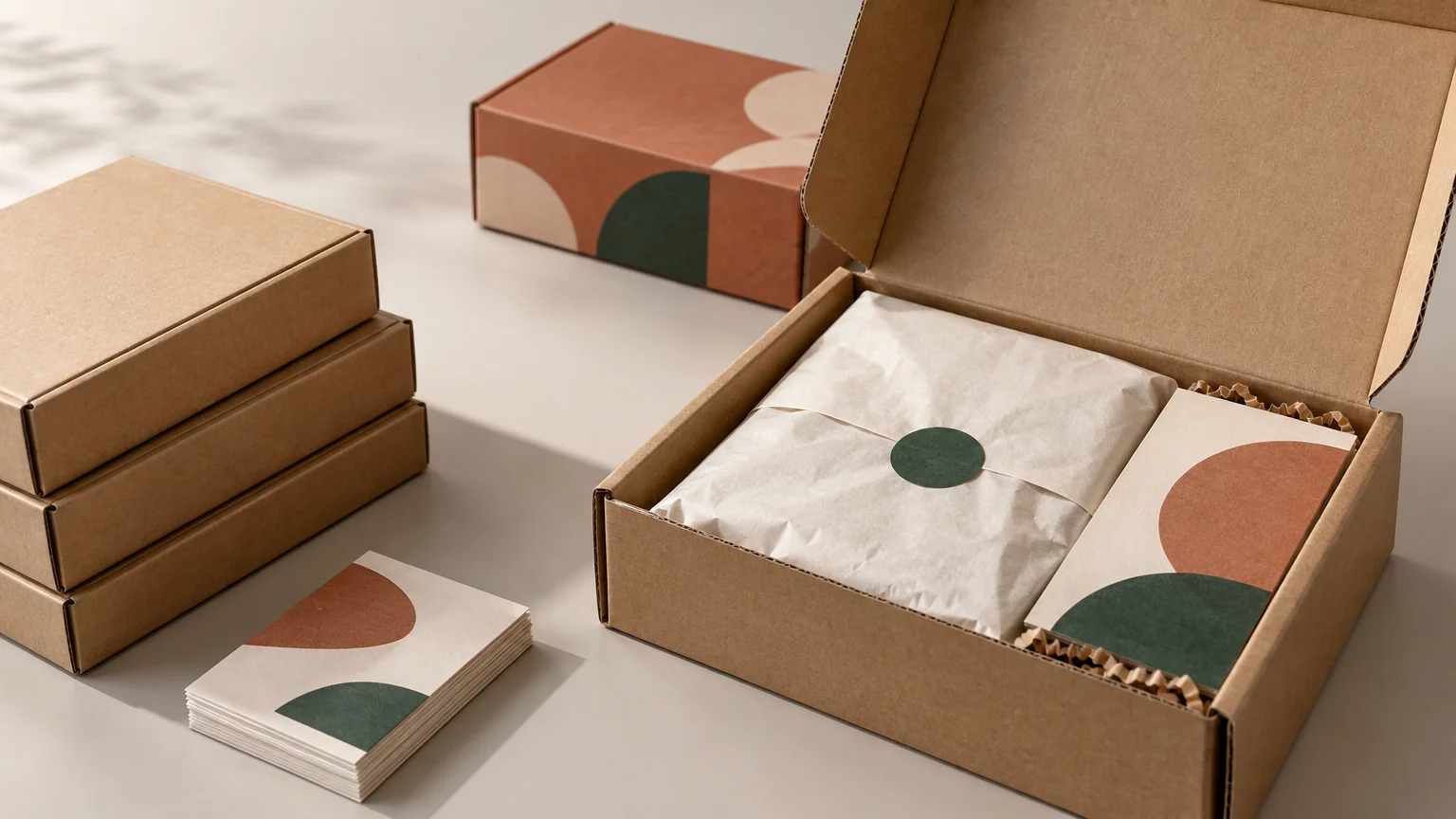
The safest way to approach custom packaging for small business orders is to standardize the shipping package first and add modular branding second. Start with one mailer, one carton, a shared branded seal or sticker, and a controlled insert. Move to fully printed boxes or mailers only when order volume, package dimensions, artwork stability, storage capacity, and fulfillment procedures justify the additional inventory.
Custom packaging for small business operations should function as a system, not a collection of attractive supplies. Every component must be ordered, stored, replenished, selected at the packing bench, and retired when its message changes. The best-looking option can become the worst operational choice if it produces oversized parcels, obsolete campaign materials, or too many nearly identical formats.
Choose the packaging architecture, not just the look
Before requesting quotes, decide how much of the package actually needs customization. A stock shipper with modular branded components is usually easier to change than a fully printed outer package. It also separates the durable part of the system—the protective shipping format—from campaign artwork that may expire.
Stock shipper plus branded seal
A plain mailer or carton paired with custom packaging stickers is a lean starting point. The shipping format can remain stable while the seal changes for a product launch, season, or collaboration. This approach still requires control: define where the sticker belongs, whether it crosses the closure, and which version the packer should use.
Stock shipper plus printed insert
An insert provides more room for care instructions, product education, referral messaging, or a campaign offer. It is also easy to version, which creates a different risk: several inserts can look valid while only one is current. Treat dated and promotional inserts as controlled inventory rather than an unlimited stack of marketing collateral.
Fully printed box or mailer
A dedicated printed shipper can make sense when the same format serves a predictable stream of orders and the artwork will remain useful long enough to consume the run. It creates a larger commitment because the structure and branding are tied together. A product change, dimensional adjustment, or rebrand can make both the packaging and its printed decoration obsolete at once.
Pre-kitted campaign or subscription package
Pre-kitting can reduce decisions at the packing station when every kit has the same contents. It can also hide inventory problems if finished kits are counted but their underlying components are not. Define whether the kit is assembled in advance or during order fulfillment, how it is identified, and what happens to completed kits after a campaign ends.
| Component | Lean starting approach | Upgrade trigger | Main operational risk |
|---|---|---|---|
| Outer shipper | One approved mailer and one approved carton | Stable volume and repeatable packed dimensions | Excess sizes, storage use, or oversized parcels |
| Branding | Shared seal or logo sticker | Consistent consumption and stable artwork | Wrong version applied at the packing bench |
| Insert | One evergreen card | A campaign needs distinct messaging or instructions | Expired offers remaining in circulation |
| Protective material | One documented method for each product family | Damage patterns show that a different pack-out is needed | Inconsistent protection or unnecessary package volume |
| Fulfillment control | Written format hierarchy and pack-out instruction | Multiple locations, campaigns, or fulfillment partners | Packers improvising with available materials |
| Product variants | Share packaging where fit and protection allow | A variant needs a genuinely different structure | Packaging choices multiplying with every SKU |
How to choose custom packaging for small business operations
Start by grouping products according to their packed requirements, not their marketing categories. Two products may share a box if their finished dimensions, protection, closure, and labeling needs are similar. Conversely, two variants in the same collection may require different formats if one is fragile or substantially larger.
For many small stores, one approved mailer and one approved carton are easier to replenish and train against than a separate package for every item. Establish a smallest-approved-format rule: packers use the smallest approved option that accommodates the order and its documented protective materials. The word “approved” matters because an improvised smaller package can compromise protection, while an improvised larger one can increase material use and shipping exposure.
Upgrade an outer shipper when the operational case is clear. Useful signals include repeatable packed dimensions, steady consumption, enough storage space, stable artwork, and a reorder cadence that leaves time for production. Branding alone is not a sufficient trigger if the business cannot reliably forecast or use the inventory.
Specify the finished shipment before ordering
Packaging specifications should describe the parcel after it has been packed, not merely the empty box or mailer. Measure the product, protective material, documentation, closure, and any expected combination of items. Record the finished outside dimensions and packed weight for each approved pack-out.
Shopify instructs merchants to configure package types, dimensions, and weights because those inputs affect shipping-rate calculations. Its shipments and packages guidance is a useful implementation reference for stores using that platform. Carrier rules still need to be checked when the packaging is put into service.
Package size can matter independently of scale weight. USPS explains that dimensional weight can apply to certain large, lightweight parcels depending on mail class and other conditions. Review the current USPS parcel standards rather than assuming a larger branded box will cost the same as a compact stock shipper.
A packaging specification sheet should record:
- Internal and external dimensions for the approved format
- Expected packed-weight range
- Compatible product families or order combinations
- Required protective material and its placement
- Closure method and tamper-seal position, if used
- A clear carrier-label area
- Customer-facing branding and insert placement
- Barcode-safe areas and warehouse-label positions
- Fallback format when the preferred package is unavailable
- Specification owner, approval date, and revision number
Test any barcode before committing to a large print run. Shopify recommends unique codes for product variants, dark ink, and avoiding curved edges, folds, tape, and visually busy areas. These principles are relevant to product or internal inventory barcodes; they should not be confused with the carrier shipping label generated for a parcel.
Treat packaging components as controlled inventory
Cartons, mailers, seals, inserts, and pre-kitted sets consume space and can stop fulfillment when they run out. Give a component its own internal identifier when the team must count, reorder, route, or distinguish it from a similar item. That identifier does not necessarily need to be a customer-visible product in the online catalog.
Unique SKUs improve inventory tracking, fulfillment accuracy, reporting, and integrations, while duplicate SKUs can create tracking problems. Apply the same discipline to packaging records: do not use one code for two inserts just because they share dimensions, and do not silently replace the artwork while retaining a version-specific identifier.
Each controlled component should have a named storage location, unit of measure, reorder trigger, and owner. Define whether a bundle of 100 stickers is counted as one pack or 100 pieces. Otherwise purchasing may think 10 units means 1,000 seals while fulfillment thinks it means 10.
Keep customer-facing packaging labels separate from warehouse and carrier labels. A brand seal supports presentation or closure. A warehouse label identifies a bin, component, or internal movement. A carrier label routes the finished shipment. The article on labels versus stickers in ecommerce packaging explains why the component’s job matters more than the casual name used for it.
Control insert and campaign versions
Version control becomes necessary as soon as packaging carries information that can expire. An evergreen care card can remain active for months, while a holiday promotion may have a narrow shipping window. Both may have the same size and paper, making visual identification difficult during a busy packing shift.
For every versioned component, record the artwork revision, proof approval, active campaign dates, eligible products or destinations, packing instruction, reorder point, and retirement method. Put a discreet version code on the physical piece when possible. The code should let a packer or supervisor confirm the version without interpreting the design.
Do not store retired and active materials in the same bin. At the end of a campaign, count the remainder and document whether it will be destroyed, archived, relabeled, or used under a specific exception. Simply telling the team to “use the new one” leaves obsolete inventory available for accidental use. For more complex calendars, use a documented seasonal packaging routing process based on SKU and ship date.
Plan the fulfillment handoff
Whether orders are packed internally or by a fulfillment partner, the handoff should specify the decision the packer must make. Shopify describes self-fulfillment as a process that includes picking, packing, buying shipping labels, and transferring parcels to carriers; it also supports external services and mixed fulfillment methods. Packaging instructions need to survive whichever model the business uses.
A useful pack-out instruction states the approved packaging hierarchy, compatible orders, protective material, insert version, branding placement, and exception path. Include reference photos if they clarify placement, but keep the written component IDs authoritative. A photograph can become outdated without anyone noticing.
Before sending packaging to a fulfillment partner, confirm:
- Which location owns and stores each component
- How packaging inventory is received and counted
- How the current insert or sticker version is identified
- Which order data triggers a special pack-out
- What happens when the preferred component is unavailable
- Who approves substitutions
- How damaged and obsolete materials are reported
- How remaining inventory is reconciled during a campaign change
Batch workflows increase the value of clear rules. Shopify can organize batches of up to 250 fulfillments using criteria such as product type or shipping destination, then support picking, packing, labels, and documents. Grouping orders is useful only when the packaging rule attached to each group is unambiguous.
Illustrative workflow: two product families, two formats
Consider a small brand selling soft accessories and boxed apparel sets. The operation approves one small mailer for accessory-only orders and one corrugated carton for apparel sets or mixed orders. Both use the same evergreen logo seal and care card.
A spring campaign adds a dated promotional insert. The evergreen card and campaign insert receive separate component IDs and separate bin locations. The pack-out rule applies the campaign insert only to orders shipping during the approved period. When the campaign ends, the supervisor removes the insert bin from the active packing area, records the remaining quantity, and closes the version.
This setup delivers visible customization without requiring a different printed shipper for every product. It also leaves a clean upgrade path. If carton volume becomes predictable and the artwork remains stable, the brand can evaluate a fully printed carton without redesigning the rest of the fulfillment controls. When comparing suppliers for that transition, use a structured print-vendor evaluation process rather than choosing on unit price alone.
Common failure points
- Buying an oversized branded box before checking the finished parcel dimensions and applicable carrier rules
- Adding a packaging size for every product instead of grouping products by actual pack-out requirements
- Letting packers choose among similar inserts without component IDs or active dates
- Placing a barcode across a fold, closure, tape line, curve, or busy artwork
- Keeping expired campaign materials beside active stock
- Shipping packaging inventory to a location that does not fulfill the corresponding orders
- Changing artwork without updating proofs, instructions, identifiers, or retirement records
- Allowing substitutions without documenting who can approve them
Packaging launch checklist
- Measure the complete packed parcel, including protection and inserts.
- Choose the smallest set of approved mailers and cartons that covers normal orders.
- Assign internal identifiers to components that must be counted, routed, reordered, or versioned.
- Create separate, labeled bin locations for similar or campaign-specific materials.
- Approve the artwork, proof, dimensions, and physical format.
- Test barcode and label placement where applicable.
- Issue pack-out instructions with format hierarchy, component IDs, and exception handling.
- Set reorder triggers using consumption, lead time, and safety stock assumptions.
- Train the internal team or fulfillment partner on current and retired versions.
- Remove obsolete campaign materials from active storage and document their disposition.
Build the simple system first
The right custom packaging system is not the one with the greatest number of branded surfaces. It is the one a small team can buy, store, select, and replenish accurately. Begin with standardized shipping formats and modular brand components. Measure the finished parcel, assign controls to versioned materials, and document the fulfillment handoff.
Once consumption is predictable and the workflow is stable, evaluate whether a fully printed shipper improves the customer experience enough to justify its inventory commitment. That sequence preserves flexibility now while creating a practical path toward more customized packaging later.