
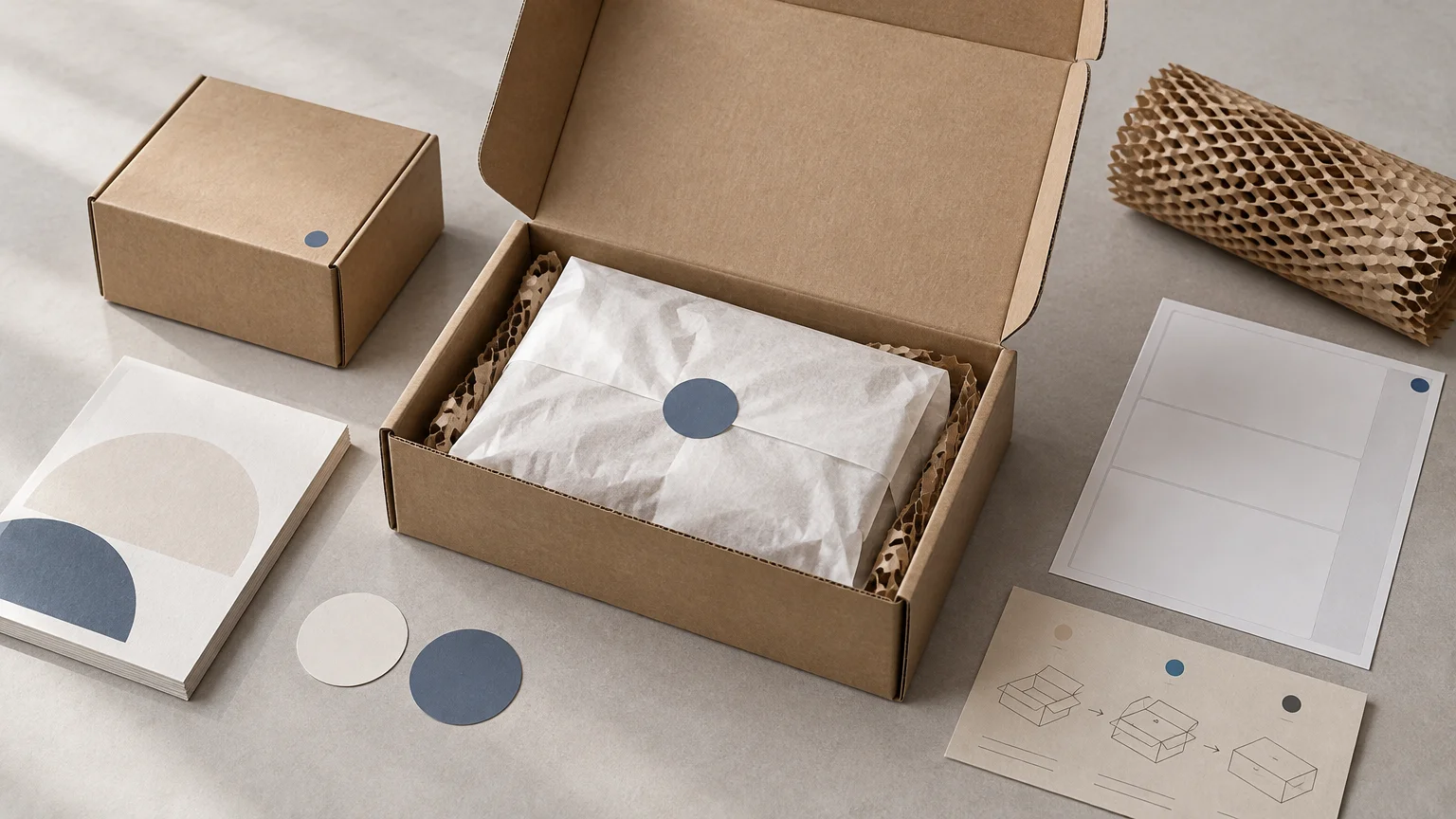
TLDR
Custom ecommerce packaging works best as a controlled fulfillment system, not a one-time box design. Define the order profiles it must support, select a small set of packaging formats, assign every physical component a SKU and revision, and document which orders receive each version. Record finished package dimensions and weight, test protection, and give one person responsibility for approving changes.
The practical objective is repeatability. A warehouse employee or fulfillment partner should be able to identify the correct shipper, protection, label, insert, and sealing method without interpreting a marketing brief. That discipline makes branded packaging easier to reorder, stock, route, and update as products and campaigns change.
Start with the order profile, not the artwork
A packaging system begins with the orders moving through it. Before selecting a custom mailer or printed box, group orders by the characteristics that change the packout: product dimensions, fragility, weight, quantity, bundle composition, sales channel, destination, return requirements, and campaign eligibility.
These groups are packaging profiles. A skincare brand, for example, might have one profile for a single nonbreakable tube, another for a three-item glass bundle, and a third for wholesale case quantities. The profiles may share artwork, but they do not necessarily need the same transit packaging or protective materials.
Keep the number of profiles low enough to operate reliably. An early-stage store often needs only a small mailer, a medium corrugated shipper, and an exception format for large or fragile orders. Adding a format can reduce empty space, but it also adds another component to forecast, store, replenish, and select correctly.
For a broader introduction to selecting branded packaging at a smaller scale, see custom packaging for small businesses. The operating model below goes further into component control and fulfillment instructions.
Choose the right packaging architecture
Customization does not have to mean printing every surface. The best architecture is the least complicated combination that protects the order, supports the brand, and can be packed consistently.
| Architecture | Best fit | Operational tradeoff |
|---|---|---|
| Standard shipper with variable branding | Changing campaigns, mixed SKUs, short runs | Low commitment and easy substitutions, but less branded exterior impact |
| Branded flexible mailer | Soft, durable, nonfragile products | Efficient to store, but unsuitable when products need crush protection |
| Printed corrugated shipper | Stable order profiles and repeat volume | Strong brand presence, but creates size-specific printed inventory |
| Product carton inside transit packaging | Retail-ready products or presentation-led unboxing | Separates presentation from shipping protection, but adds material and packing steps |
I would usually make the protective structure stable and place frequently changing creative on a sticker, sleeve, card, or insert. That separates operational risk from campaign work. Teams can source custom packaging stickers for variable branding without replacing an otherwise usable stock of corrugated shippers.
Corrugated style codes can help buyers and suppliers identify a general box construction. The FEFCO code system covers common corrugated designs, including designs relevant to retail and ecommerce, but a style code is not a complete performance specification. Board construction, dimensions, closures, print, tolerances, and intended load still need to be documented. Review the FEFCO code system when discussing structural styles with a converter.
Turn custom ecommerce packaging into a bill of materials
Once the architecture is selected, create a packaging bill of materials, or BOM, for each order profile. Treat every item consumed during packing as a component, even if it appears inexpensive or interchangeable.
- Outer shipper, mailer, or transit carton
- Product carton, tray, divider, pad, or protective wrap
- Closure tape, sealing label, or tamper-evident component
- Shipping, routing, compliance, and product labels
- Packing slip, return instructions, promotional insert, or care card
- Void fill and any quantity limit that applies to it
Each BOM line should include a component SKU, supplier description, dimensions, material or construction, artwork revision, quantity per order, storage location, reorder point, lead-time assumption, and approved substitution rule. If a component has printed copy, add an owner and effective date.
Do not use a product name such as “medium branded box” as the entire specification. Record whether dimensions are internal or external, the measurement order, closure method, print file, approved proof, and any orientation requirements. Then measure the completed parcel after it has been packed and closed. The finished outside dimensions and shipping weight are the values needed for rating and operational checks.
Write packout rules that can be executed without guesswork
The BOM says what a profile consumes. The packout specification says when and how to use it. A useful specification identifies the qualifying order, component quantities, packing sequence, exclusions, inspection points, and the approved reference image.
| Specification field | Example instruction |
|---|---|
| Profile ID | DTC-GLASS-03, revision B |
| Qualifying order | One three-bottle bundle shipping domestically |
| Outer package | CORR-08 shipper, one per order |
| Protection | Insert TRAY-03; all bottle positions occupied |
| Printed components | CARE-02 plus RETURN-01 |
| Exclusions | Do not use for international, wholesale, or subscription renewal orders |
| QA evidence | Compare closure and orientation with approved packout photo |
| Control | Effective June 1; operations approval required for substitutions |
Use explicit exclusions. “Add the summer card to qualifying orders” leaves too much room for interpretation. A usable rule identifies the qualifying SKUs, applicable channel, destination or market, ship-date window, fulfillment location, and what happens when inventory runs out.
Seasonal and promotional versions should be mapped through data that the fulfillment workflow can actually read. A campaign name in a marketing calendar is not enough. Use a product SKU, order tag, bundle identifier, destination, channel, or controlled date rule, then test the rule with representative orders. The same approach applies when routing seasonal packaging by SKU and ship date.
Keep operational documents separate from promotional inserts
A packing slip supports order verification and customer service; a promotional insert supports marketing or education. They may travel in the same parcel, but they should not be managed as the same component.
Shopify says its packing slips can display details including items, addresses, SKUs, quantities, and product information, and that the template can be customized using Liquid. Shopify also documents self-fulfillment, fulfillment services, and combined methods, with orders processed individually, in bulk, or in batches. Those capabilities can support packaging workflows, but the physical routing rule still needs to be translated into a field or instruction available to the packing location.
Give physical inserts their own SKUs and revision IDs. That makes it possible to count remaining stock, stop obsolete legal or promotional copy, and distinguish a missing insert from a printing-template problem.
Control shipping exposure without sacrificing protection
Reducing unused cube can lower material use and may affect transportation charges, but smaller is not automatically better. A tight packout that transfers impact directly to a fragile product can cost more in damage, reshipments, and support work than it saves.
Measure every approved profile after final closure, including bulges and overfilled seams. USPS states that parcel size, shape, and weight affect pricing. Its dimensional-weight provisions apply to specified domestic services under defined conditions, including certain parcels over one cubic foot. Treat those details as USPS-specific and verify the current rule for the service being purchased rather than applying it to every carrier. Check current USPS parcel size and weight standards.
A useful optimization sequence is to remove unnecessary empty space, confirm that the product cannot migrate into a vulnerable position, measure the closed parcel, and then compare shipping costs and damage results. Avoid changing the shipper solely from an unverified estimate of dimensional savings.
Decide when to pre-kit
Pre-kitting combines packaging components before an order reaches the packing station. It can improve speed and consistency when the same set repeats frequently. It can also trap usable boxes, cards, and stickers inside obsolete kits when artwork, offers, or product assortments change.
Pre-kit when the configuration is stable, order repetition is high, the component set has a shared life cycle, and the labor saved justifies a separate inventory item. Pack on demand when campaigns change frequently, components are shared across profiles, demand is uncertain, or one item may need to be recalled or revised independently.
A useful compromise is a partial kit: assemble stable protective parts in advance but add dated inserts, market-specific documents, and promotional components at packing. This preserves speed without locking volatile materials into finished kits.
Test the product-and-package system
Approval should cover more than an attractive empty-box sample. Build prototypes with the real product, closures, inserts, and void fill. Check assembly time, product movement, label placement, barcode readability where relevant, opening experience, and the condition of both product and packaging after representative handling.
ISTA treats testing as an evaluation of the product-and-package system. Its guidance recommends defining acceptable damage before testing and retesting when the product, package, or process changes. It identifies ISTA 3A for certain direct-to-consumer parcel shipments at or below 150 pounds and ISTA 3L for retailer-fulfilled ecommerce shipments. The appropriate protocol depends on the actual distribution environment and risk. Consult ISTA’s design and testing guidance when formal evaluation is warranted.
Formal testing is not the only feedback mechanism. Track damage type, affected SKU, packaging profile, fulfillment location, carrier or service, and packout revision from live shipments. A rising failure rate should trigger investigation even if the artwork and box style have not changed.
Use change control to protect the system
Packaging changes often arrive as small requests: use a different board, reduce void fill, substitute a label, move the insert, or fit one more item into the box. Each can affect protection, dimensions, packing time, inventory, or customer communication.
Assign one change-control owner and require reapproval when the product, package structure, dimensions, materials, closure, pack sequence, supplier, or distribution path changes materially. The owner should identify affected BOMs, consume or quarantine old inventory, update warehouse instructions, set an effective date, and decide whether testing is needed.
Use revision IDs instead of silently replacing files. If two versions must coexist, define exactly which orders receive each one. For labels and stickers, the operational distinction should follow the job they perform rather than the name used by a supplier; labels and stickers play different roles in ecommerce packaging.
Launch checklist
- Group representative orders into a small number of packaging profiles.
- Approve the protective structure before finalizing decorative artwork.
- Create SKUs and revision IDs for every stocked component.
- Document dimensions, materials, artwork files, quantities, and substitution rules in the BOM.
- Write executable routing rules based on order data available to the fulfillment location.
- Record finished outside dimensions and weight for every approved profile.
- Create a packout instruction with exclusions, an approved photo, and an effective date.
- Set reorder points using demand, lead time, storage capacity, and campaign end dates.
- Prototype with the real product and define acceptable damage or presentation defects.
- Name the person who approves substitutions, revisions, depletion plans, and retesting.
Build the smallest system that stays controlled
The strongest custom ecommerce packaging system is not necessarily the one with the most printed components. It is the one that protects the order, expresses the brand, and gives fulfillment teams unambiguous instructions without creating excessive inventory.
Start with one high-volume order profile. Build its BOM, packout specification, finished measurements, routing rule, and change process. Once that profile runs reliably, add another only when a meaningful product or fulfillment difference requires it. That sequence turns custom packaging from a collection of purchases into an operating system the business can maintain.