
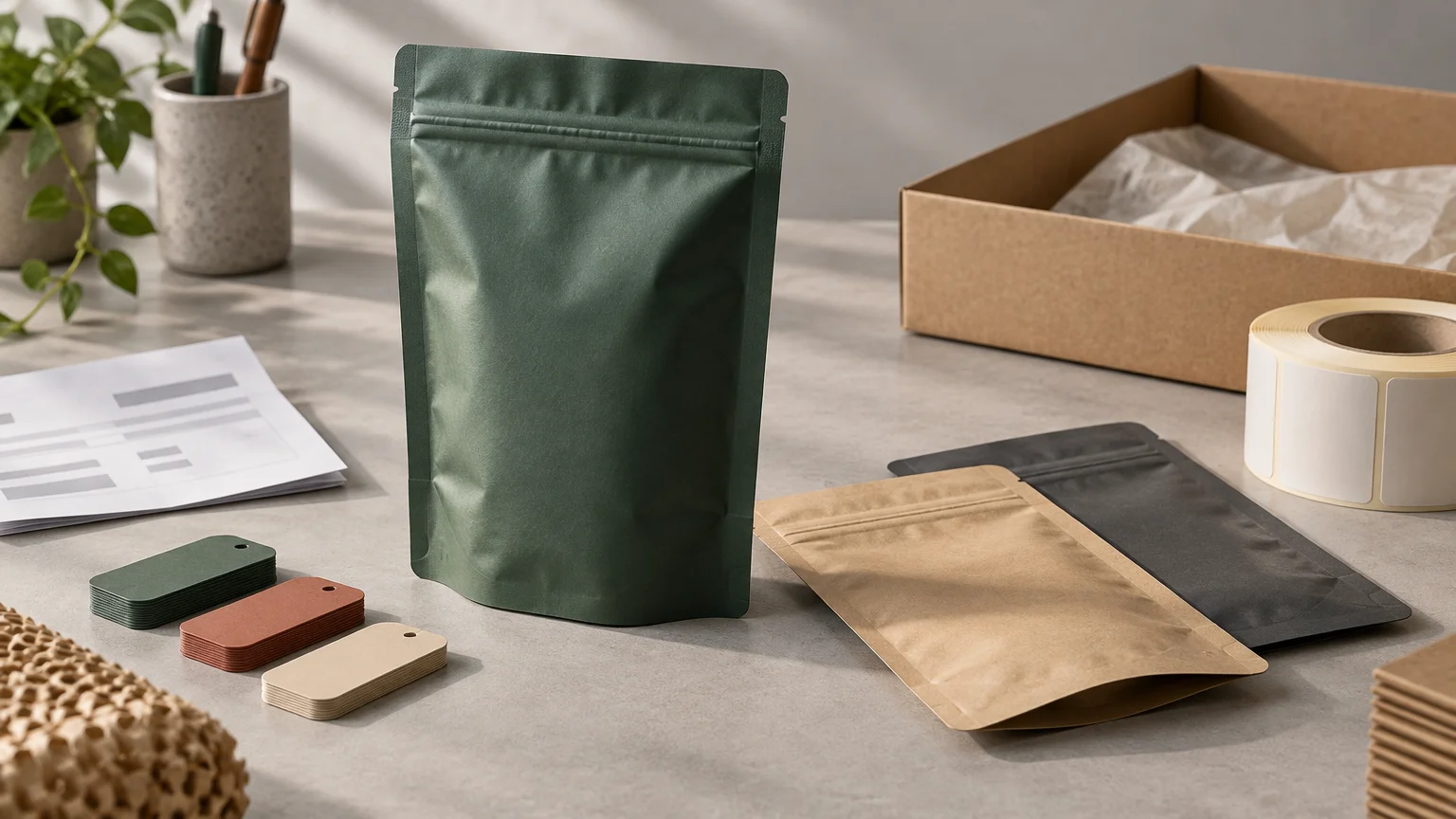
Custom stand up pouches fit best as primary product containers within an ecommerce packaging system. They can hold the product, carry its branding and support storage or display, but they normally still need a separate mailer or carton for parcel shipping. The operational challenge is therefore larger than choosing an attractive pouch: the brand must control the pouch specification, filling process, artwork version, inventory record and final shipped configuration.
Treat each physical pouch configuration as a packaging SKU. Define its dimensions, gusset, film structure, closure, finish and artwork before ordering. Then test it with the actual product and the complete fulfillment pack. That approach prevents a common failure: approving a pouch that looks right on screen but creates trouble during filling, sealing, storage or shipping.
The pouch has a specific job in the packaging stack
A stand-up pouch uses a bottom gusset that opens to form a base, allowing the filled package to stand for storage or display. Available configurations may include zippers, tear notches, hang holes, windows, spouts and degassing valves. Those features are options, not universal characteristics of every pouch.
In an ecommerce operation, the pouch can perform several jobs at once: contain the product, present required information, provide a customer-facing branded surface and support repeated opening when the construction includes a suitable closure. It should not automatically be treated as parcel-ready packaging. Flexible film can still face puncture, abrasion, compression, leakage or seal damage in a carrier network.
The complete packaging stack might include the pouch, a product or regulatory label, an insert, protective material and an outer shipping package. Brands developing food applications should coordinate this work with the broader controls described in the custom food packaging workflow. For a wider packaging-system view, see the framework for custom ecommerce packaging.
Choose between fully printed pouches and labeled stock pouches
The first commercial decision is whether to print the pouch itself or apply labels to an unprinted or minimally printed stock pouch. Neither model is universally better.
A fully printed pouch can consolidate branding and product information into one component. It may suit stable products with established artwork and enough demand to consume an economical production run. Its main operational drawback is that every printed version becomes dedicated inventory. A formula change, compliance update, campaign redesign or barcode correction can leave unusable packaging on the shelf.
A stock pouch plus label separates the container from the variable graphics. This can work better for launches, seasonal flavors, small catalogs and products whose information changes frequently. The tradeoff is an additional component and application step. The label must adhere to the selected film and finish, remain readable after filling, and avoid interfering with seals, zippers, windows or gusset movement.
If stock pouches need a short-run branded label or sticker, customstickers.com offers custom labels, stickers and related artwork preparation. The label itself should be managed as a controlled packaging component rather than ordered informally whenever stock runs low.
| Production model | Best operational fit | Main control point |
|---|---|---|
| Fully printed pouch | Stable artwork and predictable consumption | Avoid excess inventory tied to one design revision |
| Stock pouch plus label | Short runs, launches and frequently changing information | Validate adhesion, placement and application labor |
| Shared printed pouch plus variable label | A product family with common branding but SKU-specific details | Keep fixed and variable information clearly separated |
Build the specification around the product and packing process
A custom pouch specification extends well beyond artwork. Supplier programs can vary by dimensions, gusset format, barrier construction, transparency and metallized or white film options. Size is generally expressed as width by height by gusset, and the gusset changes both the footprint and usable capacity.
Do not select the pouch from a nominal fluid-ounce listing alone. Such capacity figures can be directional for dry products because actual fill weight depends on product density, settling behavior and required headspace. A lightweight, irregular product and a dense powder can require different pouches even when their net weights look similar in a catalog.
For each candidate size, run a physical fill trial with production-representative product. Confirm the target net quantity, headspace, opening clearance, seal area and filled footprint. Check whether the pouch remains stable after filling and whether operators can close or seal it without product contaminating the sealing surface.
The specification record should cover the following decisions:
- Finished width, height and gusset dimensions, including the measurement convention used by the supplier.
- Film or laminate structure, barrier requirements, opacity and finish.
- Fill method, target net quantity, expected product density and required headspace.
- Closure and opening features such as a zipper, tear notch, spout or valve.
- Seal method, seal width and areas that must remain free of print, labels or product residue.
- Artwork file, approved dieline, print orientation, barcode location and revision identifier.
- Case pack, supplier item number, receiving location and replenishment owner.
Barrier, finish and feature availability depends on the supplier and pouch construction. A zipper, valve, window or attractive finish does not establish that the package has the required oxygen, moisture, aroma, light or grease performance. Confirm the selected structure rather than relying on “stand-up pouch” as if it were a complete material specification.
Food-contact documentation belongs in the purchasing record
For food applications, visual approval is not enough. The FDA defines a food-contact substance in relation to materials used in manufacturing, packing, packaging, transporting or holding food, when the substance is not intended to have a technical effect in the food. Food-contact substances that are food additives must be authorized for their intended use before marketing in the United States. The FDA overview of food packaging and contact substances provides the relevant regulatory starting point.
Documentation must match the intended use and the actual supplier. FDA’s Food Contact Substance Notification inventory identifies the substance, manufacturer or supplier, intended use, limitations and specifications. An effective notification applies only to the identified manufacturer or supplier within its stated limitations.
Ask the pouch supplier for the exact film structure and applicable intended-use documentation, including use limitations. Include inks, adhesives, coatings, zippers, valves and spouts where relevant. Store those records with the approved specification instead of leaving them in an individual buyer’s email. A material described generally as “food safe” is not a substitute for documentation tied to the construction and use conditions being purchased.
Control artwork versions like physical inventory
Custom pouches can become obsolete even when the physical material remains intact. A changed ingredient panel, claim, barcode, net quantity or brand design can strand an otherwise usable production run. Version control should therefore start before a purchase order is released.
Assign every active configuration a packaging identifier and revision. The record should connect the supplier SKU, approved dieline, final artwork, material construction, closure, finish, case pack and receiving location. Record the effective date for a new revision and decide explicitly whether old and new stock may be consumed together.
Avoid using a filename such as “pouch-final-v2-new.pdf” as the primary control. Put the revision in the packaging record and purchase order, and require receiving staff to verify it against the carton label or packing documentation. When a new version arrives, quarantine it until the change owner confirms which finished-product lots may use it.
Map pouch inventory to sellable products
A pouch is packaging inventory, but its consumption is driven by sellable product orders. Shopify manages inventory at the variant level, with an inventory item associated with a product variant and quantities maintained at one or more locations. Shopify’s variant documentation explains that underlying model.
The ecommerce product record does not need to contain every packaging specification. It does need a dependable relationship to the bill of materials or packing instruction used by the warehouse. If two variants use different pouch sizes, artwork or closures, they should not point to one vague component called “large pouch.” Give each physical configuration its own identifier.
For a simple operation, the relationship might be one sellable unit to one pouch, one product label and one insert. Bundles and multipacks require additional logic. A three-pack may use three primary pouches but only one shipping carton and one insert. Forecast packaging from those consumption rules rather than assuming that one customer order consumes one of every component.
Set replenishment around expected usage, supplier lead time, production variability and a defined buffer. Also review the risk of obsolescence. Ordering more units can reduce the apparent unit cost while increasing cash tied up in packaging that only one SKU or artwork version can use.
Design the fulfillment step before approving the order
The pouch should move through filling and fulfillment with as few judgment calls as possible. Define which side faces the operator, where labels go, how closures are checked and how finished units are staged. If the process requires repeated measuring or visual interpretation, create a fixture, placement guide or approved sample.
Run a timed pilot using the intended pouch, product, label, sealer and shipping package. The goal is not merely to estimate speed. Look for product caught in zipper tracks, wrinkled labels, contaminated seal areas, unstable filled pouches and barcodes that curve or disappear into a gusset.
Then test the complete shipped configuration. The International Safe Transit Association maintains procedures for packaged products moving through parcel delivery in an overbox. Its package testing procedures support evaluating the pouch, product, dunnage and outer package as one system rather than evaluating the pouch alone.
A practical pilot should include representative fill quantities and enough units to expose variation. Check for leakage, seal failure, abrasion, print damage and product migration after the package has been handled in multiple orientations. Document the final pack pattern so fulfillment teams do not improvise the outer package after launch.
Make environmental claims construction-specific
Avoid applying a broad recycling or compostability claim to the pouch family without checking every component. Film, zipper, valve, spout, label and adhesive can have different end-of-life characteristics. Supplier descriptions may also distinguish between a component being called compostable and being certified compostable.
The FTC says recyclable claims should be qualified when suitable recycling facilities are not available to at least 60% of consumers or communities where the product is sold. Its compostability guidance calls for competent and reliable scientific evidence and may require qualification when appropriate facilities are not widely available. Review the FTC summary of the Green Guides before placing these claims on artwork that may remain in inventory for months or years.
Use a release checklist before purchasing
- Approve the product quantity, density, headspace and filling method.
- Confirm width, height, gusset and the supplier’s measurement convention.
- Approve the exact material structure, barrier properties, finish and opacity.
- Confirm zipper, notch, valve, spout, window or hang-hole requirements.
- Validate food-contact or other application-specific documentation where relevant.
- Test artwork on the supplier’s approved dieline and verify barcode placement.
- Run filling, sealing, storage and handling trials with production-representative product.
- Test the pouch inside the intended parcel mailer or carton.
- Create the packaging SKU, revision record, bill-of-material relationship and receiving check.
- Set reorder ownership, lead-time assumptions and a plan for artwork transitions.
The right pouch is the one the operation can control
Custom stand up pouches can deliver a strong customer-facing package without the bulk of a rigid container, but the design file is only one part of the purchase. Size, barrier, closure, compliance records, filling behavior, inventory and parcel protection determine whether the format works operationally.
Start with a physical fill trial and a written specification, not a large print run. Decide whether the product needs a fully printed pouch or can use a shared stock pouch with controlled labels. Then connect the approved component to inventory and fulfillment instructions. That sequence turns a custom pouch from an isolated packaging expense into a repeatable part of the ecommerce system.
References
- Custom Stand Up Pouches for Packaging | Zippers & Barriers | Avery
- Test Procedures – International Safe Transit Association
- SEE_Brand_Stand-Up Pouches_Sell Sheet_ENGLISH.indd
- noissue Custom Pouches – noissue
- Food Packaging & Other Substances that Come in Contact with Food – Information for Consumers | FDA
- Inventory of Effective Food Contact Substance (FCS) Notifications | FDA
- Shopify Help Center | Variants
- Environmental Claims: Summary of the Green Guides | Federal Trade Commission